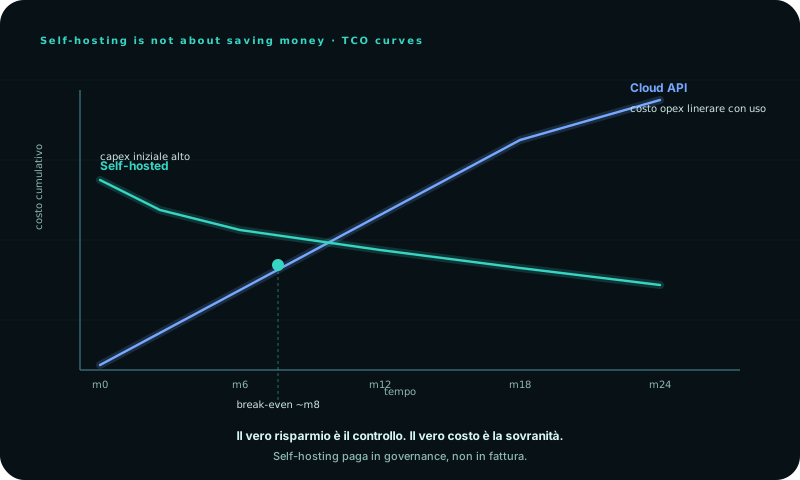
When your data never leaves your machine, it's not a preference — it's an architectural boundary. In some contexts it's the only option that makes sense.
When you run models locally, you see things you can't see from outside. When you call a cloud API, you get an answer. When you run the same model on your own hardware, you get behavior.
Different models, same prompt — different answers. Same model, different GPU — different throughput. Same stack, different CUDA — different stability. Same machine, higher load — different everything.
At first it looks like noise. Then patterns: how inference degrades under memory pressure, how drivers affect output consistency, how scheduling and runtime ripple through the pipeline.
None of this is visible from an API call. It only shows when you own the full stack.
Installing Ollama or Open WebUI is the easy part. The real work comes after: aligning the entire stack, resolving silent conflicts between CUDA, GPU drivers, and inference runtime.
You don't learn this from tutorials. You learn it by running systems, breaking them, and watching what happens.
At some point the question changes. You stop asking "which model is better?" You start asking "how does this system behave under real conditions — and what can I control?"
Cloud gives you access to models. Self-hosting gives you access to the system around the models. The model is one variable. The environment is the rest.