Companies that use AI for development
Technical control over repositories and artifacts.
Deterministic Verification
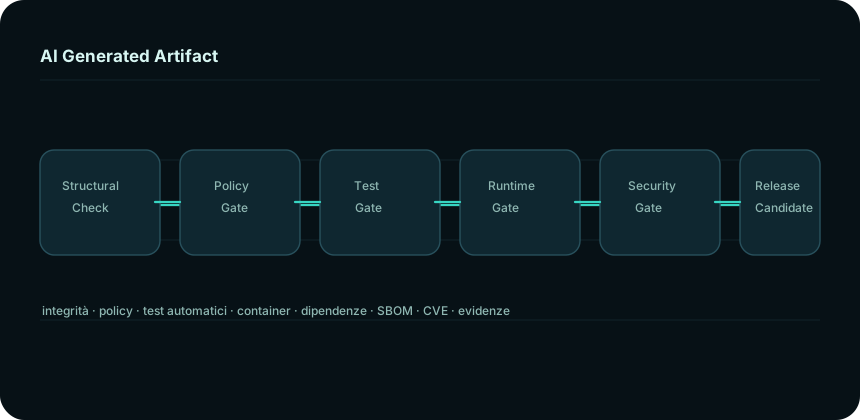
I apply a deterministic verification approach to artifacts produced or accelerated through AI: structure, policy, tests, runtime, dependencies, security, and operational behavior.
AI accelerates. Systems thinking governs.
A quickly-generated prototype may look correct but hide security issues, fragile dependencies, wrong assumptions, weak configurations, or untested behaviors.
AI generates. The pipeline verifies. Only what passes the gates becomes shippable.
Explicit technical layers that turn a generated artifact into a release candidate.
Tommaso Bilotta ha formalizzato questo approccio nel working paper “Deterministic Artifact Verification Pipelines for AI-Generated Software Systems”.
The paper addresses the asymmetry between the near-zero marginal cost of LLM-based code generation and the persistent cost of verification, proposing a deterministic pipeline to validate AI-generated software artifacts.
Verification matters when generation speed must turn into delivery reliability.
Technical control over repositories and artifacts.
Gates and tests to reduce debt and risk.
Repeatable method for client projects.
Evidence, policy, dependencies, and controlled runtime.
A technical audit can clarify what's ready, what's fragile, and what must be fixed before production.