I've been testing several abliterated models in my self-hosted lab. Once alignment constraints are reduced, you realize how much technical reasoning is locked behind safety filters in public models.
These models do not hesitate. They do not moralize. They do not stop where reasoning becomes technically interesting. They follow the chain: exploit logic, attack-surface analysis, evasion patterns, code-level reasoning around suspicious behavior.
For anyone in offensive security, that is not curiosity. It is a practical advantage.
Now add agents. An agent observes the environment, calls tools, inspects outputs, revises its plan. In offensive security: workflows that chain discovery, classification, exploitability assessment, and reporting in a loop.
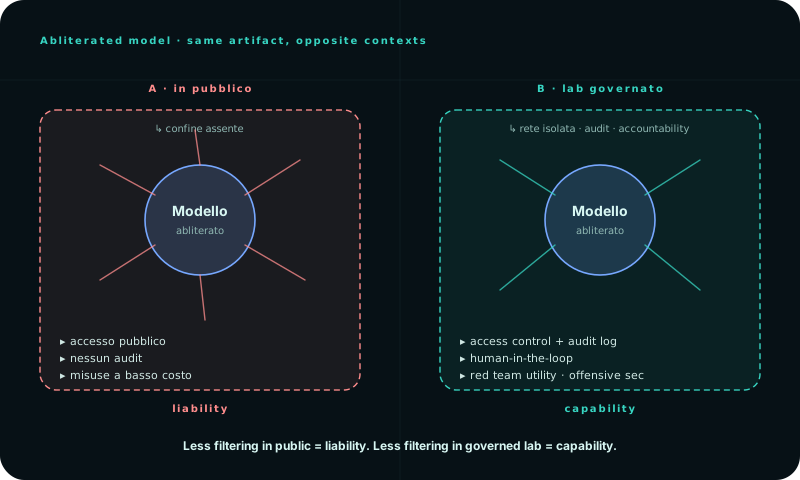
Heavily filtered public model → polite assistant. Abliterated model in a governed isolated lab → something much closer to an AI-augmented adversary that can stress-test defenses.
Warning. A 2025 study identified over 11,000 uncensored LLMs on Hugging Face, some integrated into malicious services. Once outside the lab, they lower the barrier to misuse.
Less filtering in public is a liability. Less filtering in a governed lab can be a capability.
That capability only works with real governance: isolated networks, strict access control, audit logs, constrained tool permissions, human-in-the-loop checkpoints, clear accountability.
Self-hosting in cybersecurity not as hobby, not as ideology. As behavioral governance of AI in contexts where thinking like an attacker is part of the job.